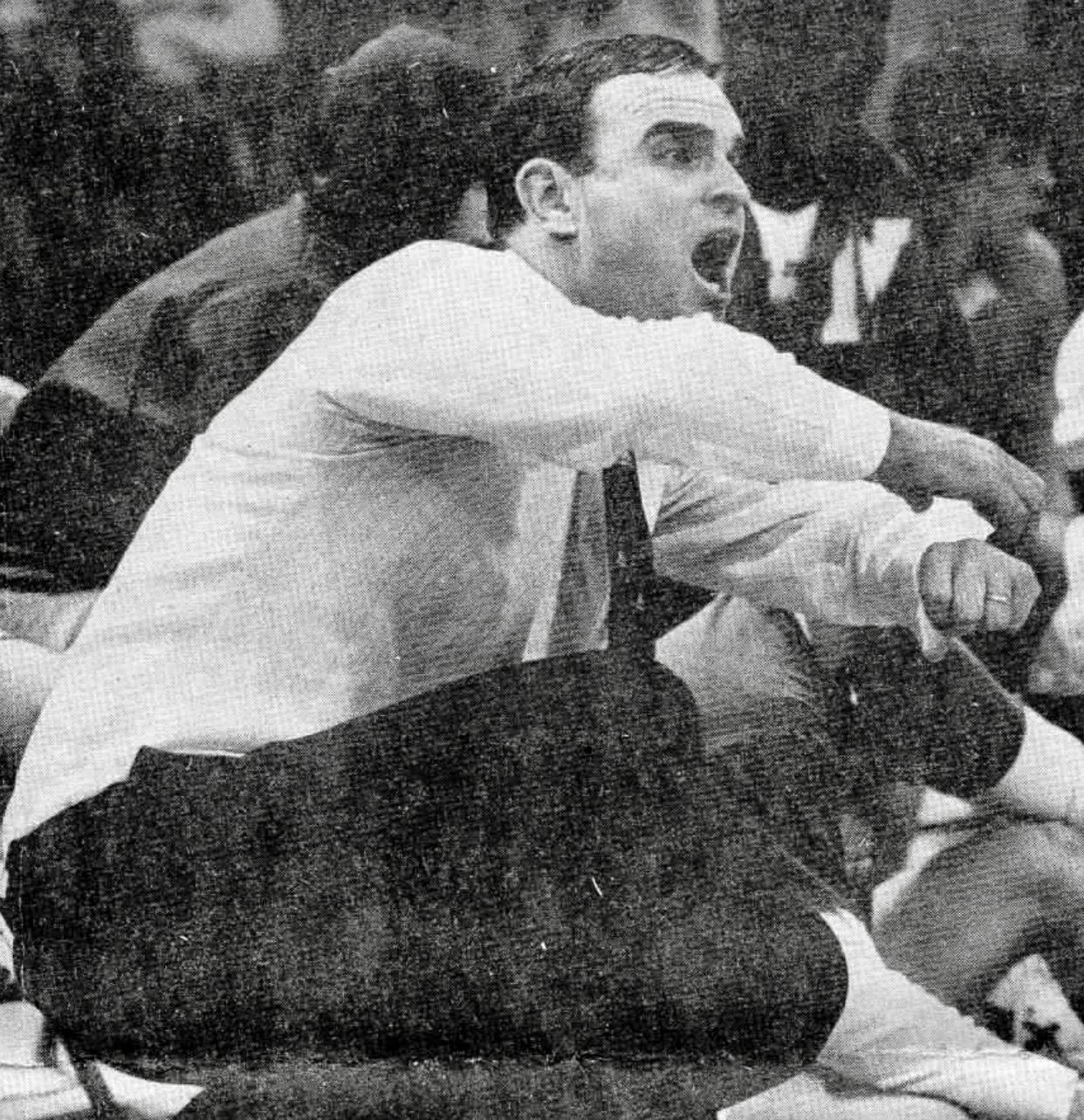
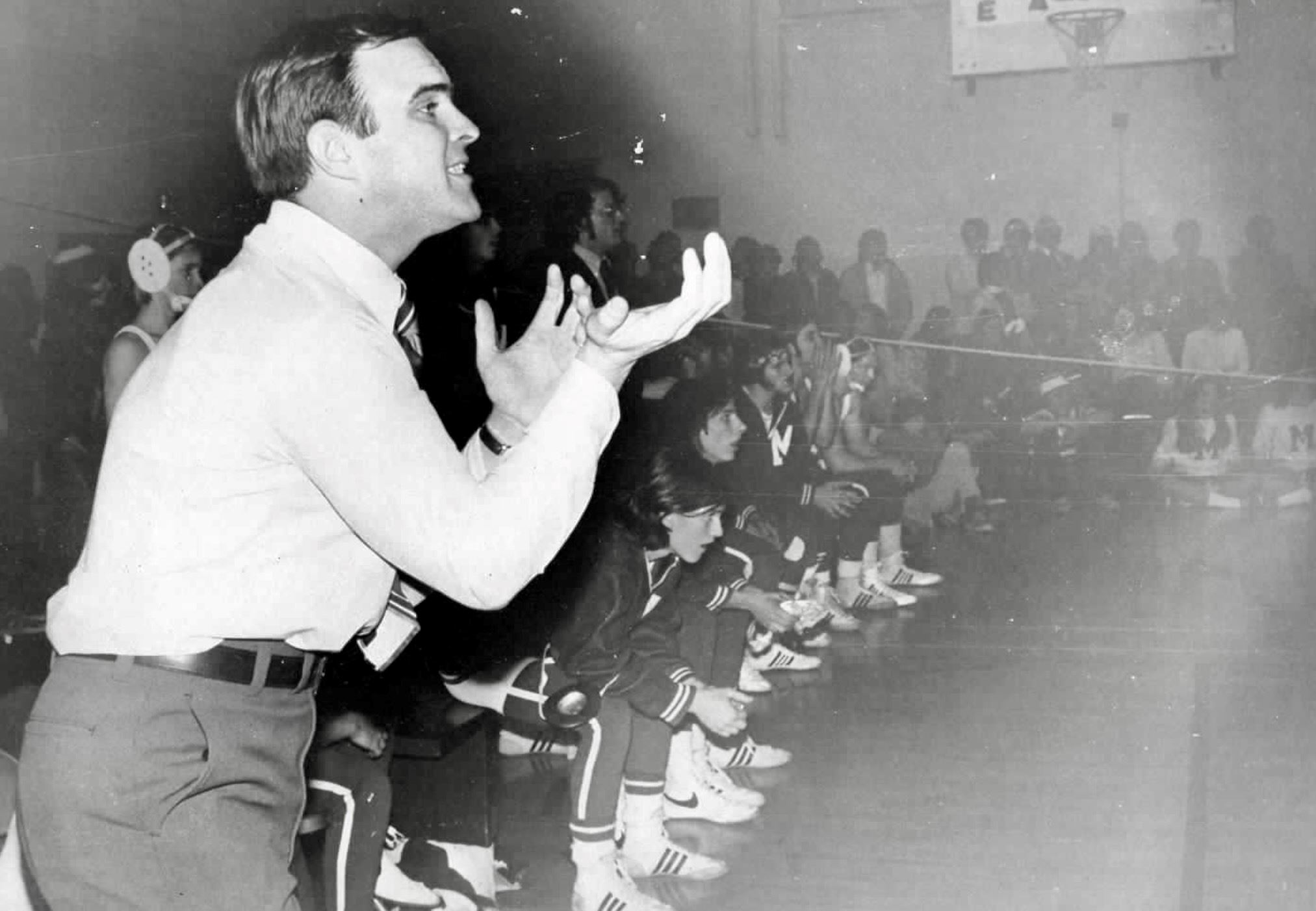
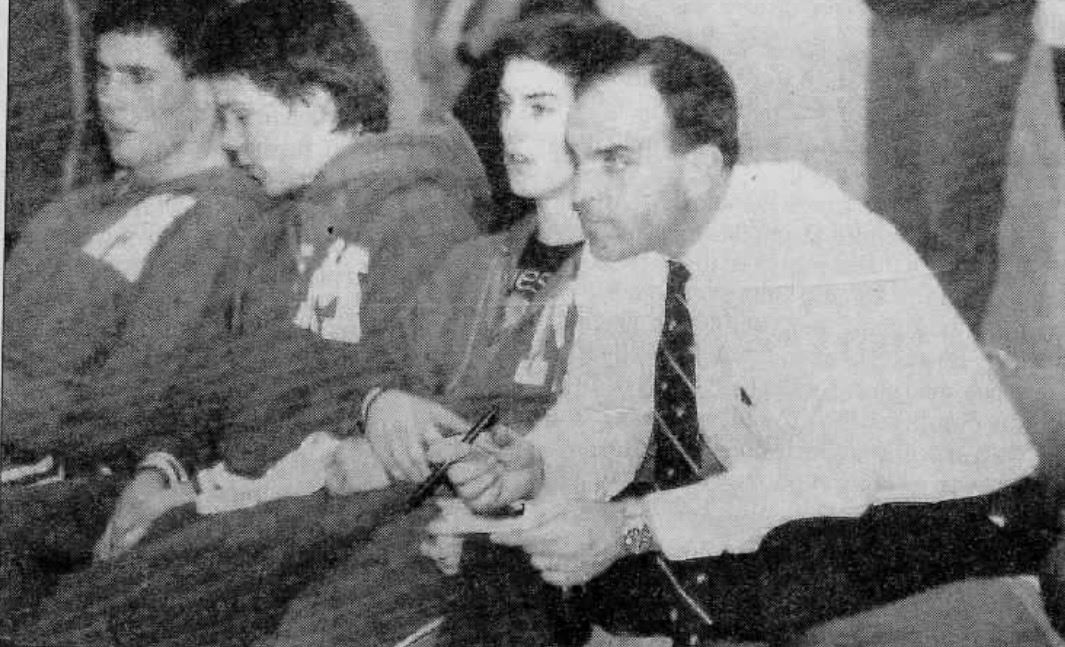
The late Coach Barry Clark helped inspire and mold countless athletes and students over the years during his time with the Middletown schools. On Feb. 9, he will be remembered forever when the gym at Gaudet Middle School is named in his honor.
 FOR IMMEDIATE RELEASE
CONTACT: Matt Sheley at (401) 842-6543 or msheley@middletownri.com
GAUDET GYM BEING NAMED AFTER COACH BARRY CLARK
MIDDLETOWN, R.I. (JANUARY 31, 2021) – In sports — as in life — there are all sorts of coaches.
Those who cajole. Yell. Encourage. Some lead the way like a general into battle, while others let the athletes determine the course of things. There are those who are quiet, scripting what they’d like to happen days before, with a good number flying by the seat of their pants.
Lifelong friend and fellow coach Bill Seiple said there will never be another like Barry Clark, the widely decorated wrestling coach and physical education teacher who died in December 2018 at the age of 72.
On Wednesday, Feb. 9, the gymnasium at Gaudet Middle School will be renamed in Clark’s honor following a quad wrestling meet at 5:30 p.m. against Davies, East Greenwich and Mt. Pleasant high schools. The ceremony is expected to begin about 7:30 p.m. in the gym at 259 Turner Road.
“The best adjective to describe Barry's coaching style was demonstrative,” Seiple said. “It wasn't unusual to see him grab one of the wrestlers off the bench, or even an assistant coach, to throw a move on to make sure the wrestler on the mat knew what Barry wanted him to do. He was constantly on his feet using whatever body language he could think of to get the wrestler on the mat to do his best. He coached his other sports in a similar manner.”
Born on February 17, 1946, he was the son of Wilbur and Dorothy Clark. He left behind his wife Mary (Landers) Clark of 48 years along with daughters Lisa O’Brien and Megan Tyson and son David Clark at the time of his passing.
A true son of Middletown, Clark was a member of the Class of 1963 at Middletown High, the first class to graduate the Valley Road school and a varsity letterman on the football team. Clark went to college at NW Missouri State, where he was on the football and wrestling teams.
A proud member of the U.S. Marine Corp Reserves, Clark was activated in 1991 for Operation Desert Shield and Operation Desert Storm. He went onto retire from the Marine Corp Reserves in 1995 with the rank of lieutenant colonel.
Always popular with students and staff alike, Clark began his teaching and coaching career at Middletown High in 1969. Throughout his close to 30 year career in education, friends said Clark taught at every level and seemingly every grade, helping to bring the fun and joy of athletics to countless students across the district.
In 1971, wrestling began at the high school as a club sport with Clark leading the way. Over the next 30 years, Clark’s teams compiled a 305-102-5 record and numerous awards, including 22 All State wrestlers, 15 state champs and six New England place winners.
Clark also coached football for 30 years as well as track and field and golf.
“Barry felt that wrestling was the best sport to bring out the best in an athlete,” Seiple said. “Size was not nearly as important as in other sports. What Barry tried to emphasize was that conditioning and move execution were more important.
“A wrestler could make a contribution to the team just by being ready to fill a weight class even if you had to move up a class or two, by not getting pinned in a match that your opponent clearly had an advantage, by scoring an extra point in a match to secure a major decision, which gave the team an extra point, or just by being at practice to give a varsity wrestler an opponent to practice with. Everybody on the team could make a valuable contribution.”
Seiple said Clark wasn’t afraid to challenge the wrestlers on his team, questioning why they weren’t able to beat the coach.
“Barry enjoyed working out. He liked to get a good sweat going so he felt like he was burning off extra calories.” Seiple said. “We started almost all practices with a long run. Barry would run with the kids most of the time and then exercise with them as they warmed up. He usually wore an extra nylon shirt to make sure he was sweating enough.
“His favorite way to motivate the upper weights, and we had a lot of great wrestlers in those weights, was to roll around with them after he had a good sweat working. He knew how to use his weight to his advantage and the wrestlers had a real hard time trying to control him with the sweat dripping off. Of course, he prodded them along with not working hard enough to be able to beat the coach and they did work hard to try to pin him.”
As for naming the Gaudet gym after Clark, Seiple said the idea was first floated by several former wrestlers and football players.
“When the high school gym was renamed for Jim Williams, we began discussing the possibility of naming the Gaudet School gym for Barry. It wasn't something that he wanted or thought he deserved, but that was his humble nature,” Seiple said. “I think the honor is well-deserved for a number of reasons. Barry was a member of the first graduating class of the high school and returned not only to teach but also to coach numerous sports. He taught in that gym and developed the wrestling program in that gym. Many students and athletes benefited from the lessons he taught in that gym.
“Not only did Barry pass along his wisdom in the classroom and on the mat, but he constantly demonstrated his sense of fairness and sportsmanship. He held himself to a high standard and expected his charges to do the same. He was an Islander through and through and supported the other teams and the system any way he could. And finally, he used his experience as a Marine Corps reservist to help many kids explore the armed forces as a way to further themselves.”
Despite what some might think, Seiple said the lessons taught in the classroom and athletic spaces were equally important.
“Wrestling allows an individual to test him or herself,” Seiple said. “It builds self-confidence, but at the same time emphasizes the importance of team success. Wrestling gives athletes of all sizes the ability to compete on an even level with their opponent.
“The harder you work in practice, the better you condition yourself, the smarter you control your weight, the better you will do in a match. When you are out on the mat there is no place to hide, no one else to blame if your opponent beats you. Success in wrestling demands personal responsibility and self sacrifice. For kids who also want to play football, wrestling gives them great opportunities to learn balance, stance, hand control, and takedown techniques that help them find success on the gridiron.”
Not surprisingly, Clark earned the kudos of both his athletes and peers for his work. Clark was named the Rhode Island “Coach of the Year” in 1980 and named to the Rhode Island Wrestling Coaches Hall of Fame in 2007. Clark was also named to the Middletown High School Athletic Hall of Fame in 2014 and selected as the “Alumni of the Year” in 2018 by the Middletown High School Alumni Association.
“Barry was the consummate team player,” Seiple said. “He wouldn't blame the refs if things weren't going his way or make any excuses and he held his charges to the same standard. He didn't try to motivate his athletes by putting down the other team. He stressed individual responsibility and fair play. The team was always the most important factor, even in an individual sport like wrestling. He demonstrated these traits in his words and his actions.”
####